Insights
Daniel Priestley's YouTube Strategy: 486 Videos
Daniel Priestley's channel is in its nineteenth year on YouTube. It has 197,000 subscribers and 11.7 million lifetime views - and not one of its long-form videos is a year old yet.

That arithmetic shouldn't work. Channels this old with numbers this size are supposed to have a decade of uploads behind them. His growth is new, fast and deliberate - and because every part of it sits in public data, it can be taken apart.
I ran his full library - 486 videos - through the analysis tools I've coded and use for my clients, alongside daily tracked subscriber history and the video transcripts.
The formulas
Seven formulas came out of the analysis. The evidence for each sits further down the article.
The takeout to try yourself: These are the formulas that show up in Daniel Priestley's content. They're what his audience rewards on his channel, at his size, in his subject. Nothing here transfers automatically to yours, and the honest way to use any of it's as a hypothesis: pick one, have your channel manager run it against your own library, and keep it only if your numbers agree.
- The format formula: the median long video does 96,000 views, the median Short 4,400 - a 22x gap per upload, and the long audience is warmer too (3.7% like rate against 2.4%).
- The topic formula: same template, topic sets the ceiling - 15x between identical titles, 549,000 against 36,000.
- The compounding formula: 5,500 views on day one, 46,600 by day 28 - the videos more than double between day seven and day twenty-eight, so the library keeps earning after launch.
- The cadence formula: one long video roughly every twelve days, with average runtimes growing from 17.5 to 18.6 minutes - scale depth, not frequency.
- The title formula: put the runtime in the headline and price the length as the deal - "25 Years of Sales Knowledge in 34 Minutes".
- The structure formula: three channels, one promise each - the face earns the attention, the method and the product convert it.
- The funnel formula: teach the full method, then sell the automated shortcut.
The takeout to try yourself: Screenshot this list. The rest of the article shows why each line earns its place.
The timeline nobody checks
Most people see a channel at 197,000 subscribers and assume steady compounding. His upload history says otherwise. It falls into three acts.
Act one: the archive. The channel was registered in 2007. Barely a dozen uploads survive from its first eighteen years, and nothing at all dated 2024. Whether the channel sat quiet or its older videos were cleared out, the effect is the same: the relaunch began from a nearly blank slate.
Act two: the Shorts sprint. On 16 January 2025 the channel came back to life, publishing Shorts only - six a week for seven months. 193 of them. In April one went properly viral: 4.4 million views from 39 seconds. By late August the channel stood at 20,400 subscribers.
Act three: the pivot. On 29 August 2025 the first long video went up, and its title is the strategy in one line: "How I Made $10 Million from Diary of a CEO". By his own account he'd have paid $6 million to appear on that show once, and the appearances made him ten. The first act of his long-form era was converting borrowed audience into owned audience. Twelve months and 28 long videos later: 197,000.
The channel joined YouTube in October 2007. Its oldest surviving Short is from 2022. Its oldest long video is from last year.
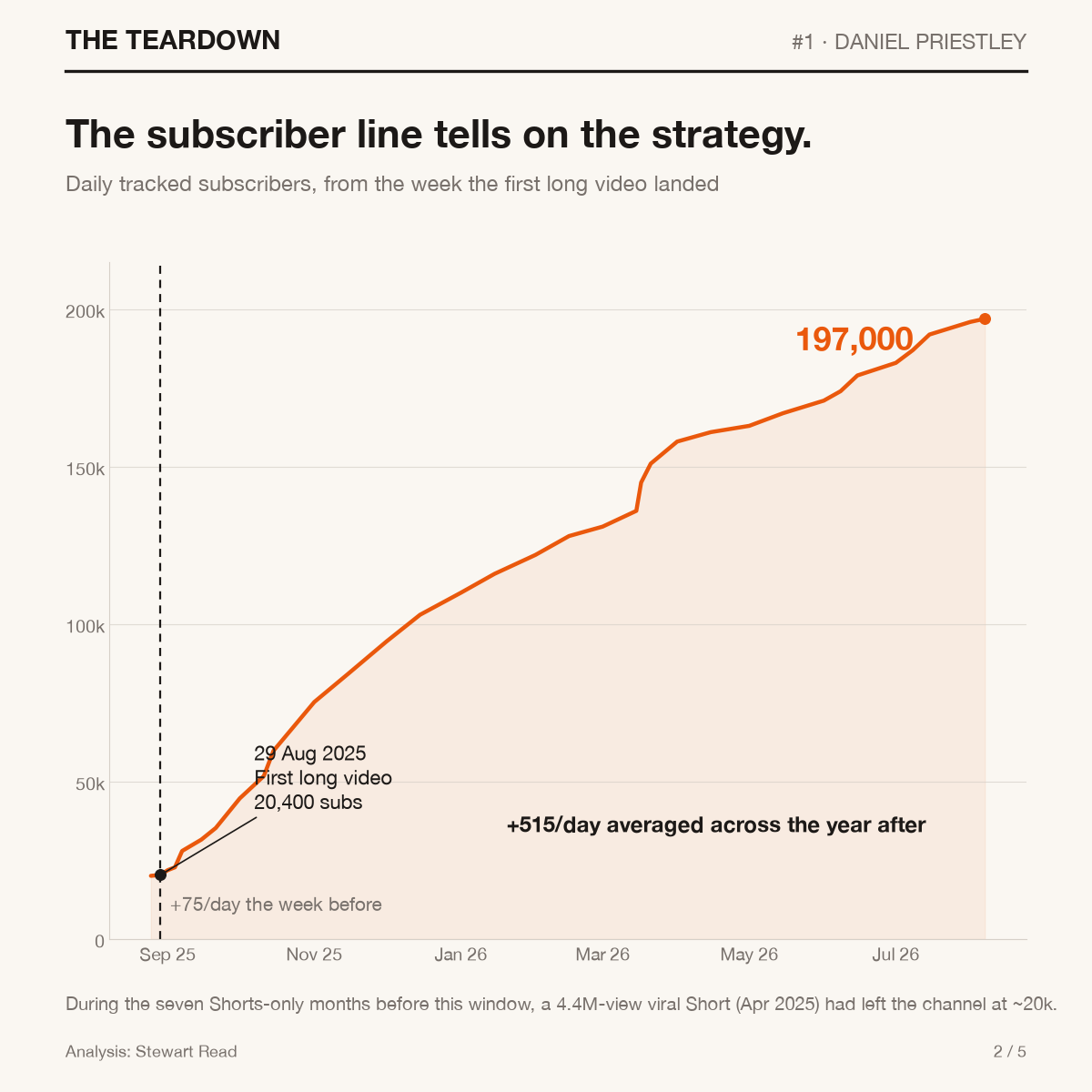
The week before that pivot, the channel was adding 75 subscribers a day. Averaged across the year after it: over 500 a day.
Seven months of daily Shorts, including a 4.4 million-view hit, moved him less than 28 long videos did. His own upload history settles the format debate for him.
The takeout to try yourself: Line your subscriber history up against your upload dates. The format that moved the line is the one to back next quarter.
The machine, in five moves
There are five moves. The rest of the article gives you the data behind each one.
Move one: point borrowed audiences at an owned format. His podcast fame built the demand before the channel did - the first long video is literally about his Diary of a CEO appearances. YouTube long-form is where that borrowed attention became an owned audience.
Move two: Shorts warm the surface; long-form converts. Six Shorts a week kept the channel present and cheap-tested topics. The subscription engine was the format he added in August, not the one he multiplied all year.
Move three: sprint the library, then let it compound. Twelve long videos in the first fourteen weeks built a bingeable catalogue fast. Because his videos are slow burners, the stack keeps earning - so the cadence could halve without the growth stopping.
Move four: run packaging as a system. Three repeatable title formulas, lengthening runtimes, chapters and next-video chains on every upload. Formulas ship velocity - but topic choice still sets the ceiling, and the transcripts below prove it.
Move five: end every video in a self-diagnosis. Teach the full method on camera, then route the viewer to a free scorecard built on his own software. The channel is the front door of a funnel, and the funnel is the business.
The takeout to try yourself: The moves work as a sequence. Borrowed audience needs an owned format waiting for it, and the format needs a funnel underneath.
Both formats run. One does the heavy lifting
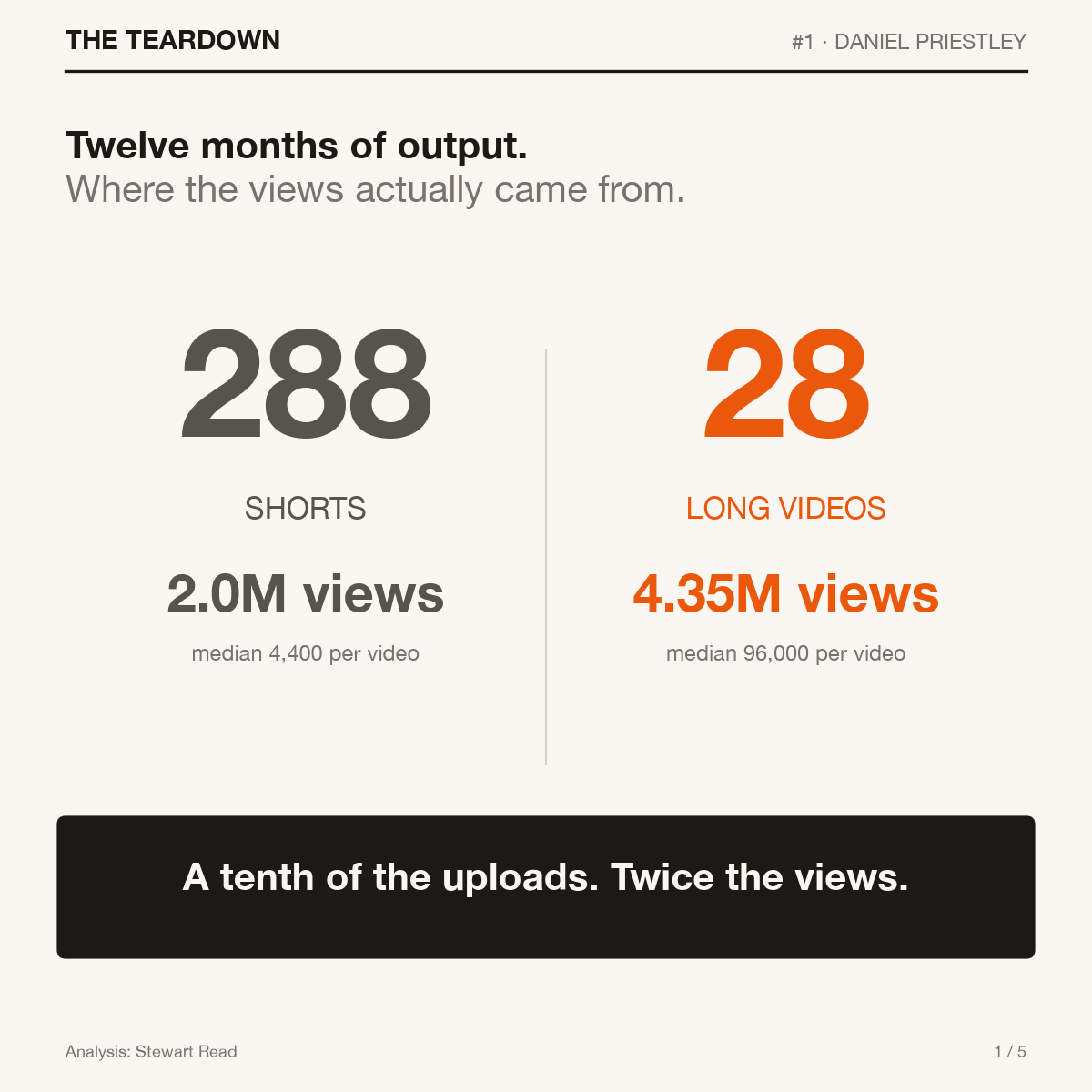
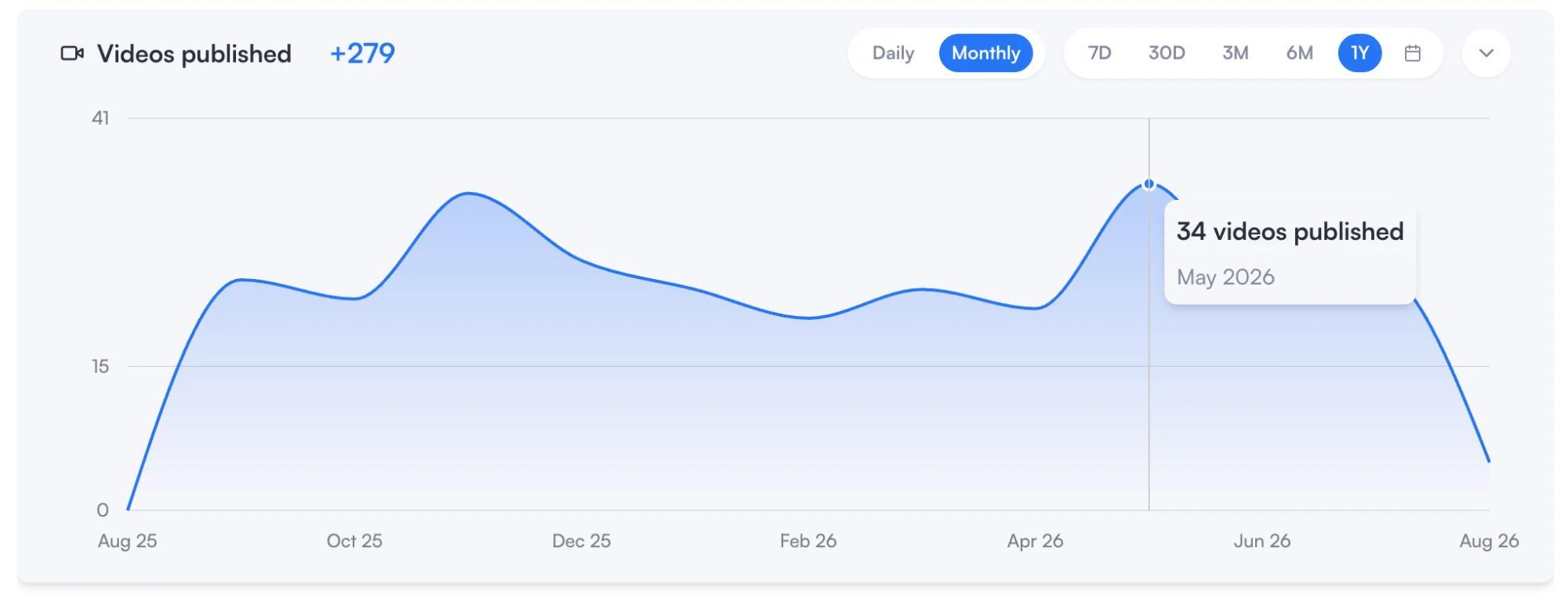
He didn't drop Shorts after the pivot - 288 of them went out in the last twelve months against 28 long videos. He demoted them.
The twelve-month scoreboard:
- 28 long videos: 4.35M views
- 288 Shorts: 2.0M views
Twice the views from a tenth of the uploads. Per video, the median long video does 96,000 views and the median Short does 4,400 - a gap of roughly 22x that holds whether you compare medians or means.
The engagement gap points the same way. His long videos run a 3.7% like rate; his Shorts run 2.4%. The long-form audience isn't just bigger per video. It's warmer.
And the cadence is the practical lesson. This isn't a daily grind: one long video roughly every twelve days, with the longest gap at 44 days. They're also getting longer - averaging 17.5 minutes in 2025 and 18.6 in 2026. He's scaling depth, not frequency.
The takeout to try yourself: Score each format on views per upload. The per-video number tells you which one deserves your production time.
Even the Shorts improved when long-form arrived
Splitting the channel's two phases shows something stranger. In the Shorts-only months, his median Short did 2,542 views. Since the long-form pivot, the median Short does 4,506 - a 77% lift on the same format, same cadence, same presenter.
I can't prove the cause from outside; that needs traffic data. The likeliest reading, and I label it as a hypothesis, is that the long videos built a subscriber base that now hands every Short a warmer starting audience. The format he demoted is performing better because of the format he promoted.
The takeout to try yourself: Judge a new format by what it does to the whole channel. A subscriber base built by one format hands every other upload a warmer start.
The firework and the asset
The 4.4 million-view Short deserves its own examination, because it's the strongest argument against chasing virality I've found in public data.
It took 86% of its lifetime views in the first 28 days. Sixteen months on, it added 71 views in the last month. It's the biggest thing the channel has ever produced, and it's finished.
Compare his biggest long video - "25 Years of Sales Knowledge in 34 Minutes", published December 2025. It took 17% of its views in month one. In its eighth month it added 40,908. It has out-earned its launch month several times over and is still climbing.
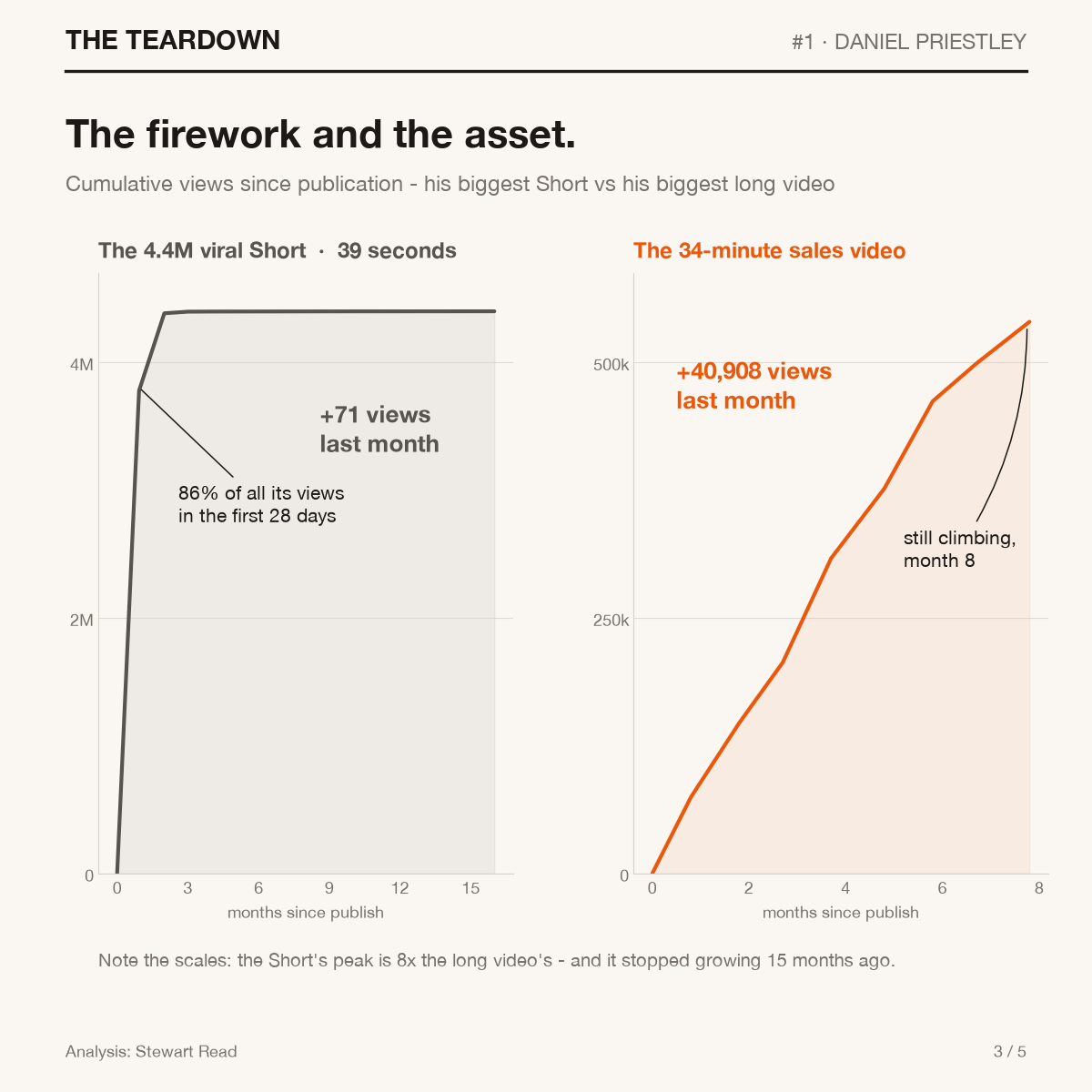
One was a firework. The other behaves like an asset - still being paid for work it did in December. For a business channel, where each video carries links, offers and a reason to subscribe, that difference compounds into everything else.
The takeout to try yourself: Check how many views your biggest video added last month. A video still earning in month eight is worth more to a business than a spike that finished in month two.
His Shorts are two different shows
This is the finding that only shows up when you classify all 458 Shorts, and I haven't seen anyone else surface it.
Sort his Shorts by topic and they split into two audiences. Roughly 85 are news-style commentary - the UK tax system, the wealth exodus, what's happening to London. The rest are business how-to and mindset clips, the same territory as his long videos.
The commentary Shorts win, and it's not close:
- Commentary: 85 Shorts, 5.29M views, median 5,844
- Business how-to: 178 Shorts, 1.07M views, median 3,617
Strip out the 4.4M outlier and commentary still wins on every measure. Eight of his top ten Shorts are commentary. None of his top ten long videos are - the long library is entirely evergreen business education.
The commentary views didn't build the channel. Five and a half million views from the Shorts-only phase left it at 20,400 subscribers. The plausible explanation - and I label it as a hypothesis, because retention and traffic data aren't visible from outside - is that a viewer who stops for a tax hot-take is a news viewer, not a business buyer. The views were real. The audience was the wrong one.
The category detail sharpens it. His commentary Shorts about tax and the UK economy run a median of 8,307 views. Every business category of Shorts sits far below that: sales and marketing clips at 3,321, business strategy clips at 2,428. The same subjects that carry his long-form barely register as Shorts.
Flip to the long library and the order inverts. Sales, marketing and lead generation is his strongest long-form category, with a median of 107,000 views across six videos, and business strategy fills ten more. The subjects his buyers care about live in long-form, and the audience meets them there.
If you've ever had a video do big numbers and produce nothing - no enquiries, no subscribers who stick, zero pipeline - this is the pattern that predicts it.
The takeout to try yourself: Sort your library by topic and ask which audience each one pulled in. Big view counts on topics your buyers don't care about are building the wrong audience.
Three channels, three jobs
He runs three channels, and the structure is a sales funnel drawn in YouTube:
- Daniel Priestley - his face. 197,000 subscribers.
- Key Person of Influence - his method. 68,300 subscribers.
- ScoreApp - his product. 21,500 subscribers.
The personal channel earns the attention. The descriptions on his long videos route it down the stack - to a free assessment, a workshop, and the satellite channels. Each channel keeps one clean promise, so the algorithm gets one clear signal per channel, and all three stay active.
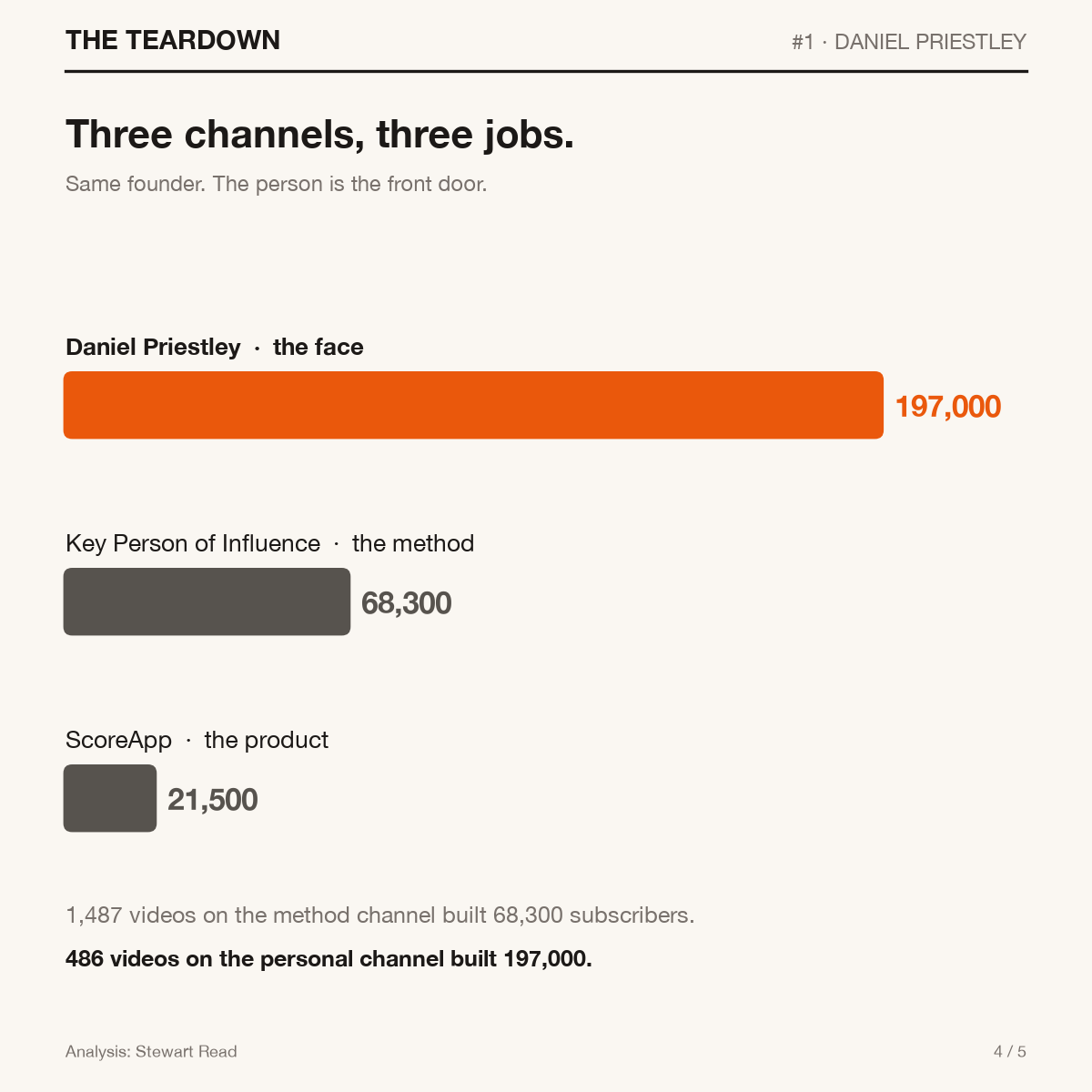
The person is winning the reach war. The method channel has published 1,487 videos since 2010 and has 68,300 subscribers. The personal channel took 486 videos to pass 197,000 - three times the subscribers from a third of the videos. The channels differ in age and cadence, so treat that as a directional signal rather than a controlled experiment. Directionally, it's loud: the face is the front door.
The takeout to try yourself: Keep one promise per channel so the algorithm gets one clear signal. A second product is a case for a second channel.
The titles sell the length
His best-performing titles do something most channels are afraid of: they put the runtime in the headline.
"25 Years of Sales Knowledge in 34 Minutes" - 549,000 views. "Give Me 29 Minutes and I'll Teach You to Make $1 Million" - 420,000. The length isn't hidden as a cost. It's priced as the deal: twenty-five years of experience, compressed into thirty-four minutes. Across all 28 long videos, a third use one of three repeating templates - runtime-in-title, "Why You Must ___", or a "$1 million" anchor that appears nine times.
A title pattern is worth trusting only once it survives a second library. The rules that held across both Hormozi channels point the same way as his: put the year in a long-form title, and on Shorts write in the first person with a number in it. The first-person rule alone came out of more than 1,600 Shorts across those two channels.
There's a subtler choice underneath. I checked the live YouTube results page for "how to build a personal brand" - his 276,000-view video on exactly that topic doesn't rank for it. "Why You Must Build a Personal Brand" isn't a search phrase; it's a recommendation-feed headline. He's playing browse and suggested, not the search bar, and the titles are built for the feed's psychology rather than the query box. That's a deliberate trade, and it suits a channel whose subscribers arrive through his podcast appearances. Most business channels aren't in that position, which is why packaging strategy starts with knowing which surface your views actually come from.
The takeout to try yourself: Find out which surface your views come from, then write titles for that surface. A feed headline and a search phrase are different jobs.
Built to burn slow
The channel's view curve backs the packaging choice. The typical long video here does around 5,500 views in its first day, 18,600 in its first week, and 46,600 by day 28 - it more than doubles between day seven and day twenty-eight. Most channels front-load; this one compounds across the month as the recommendation system finds its audience.
The library is engineered for that. Every long description carries timestamped chapters and a bulleted list of what the video covers. Most carry a Watch This Next link to a specific video, and the videos end by routing you to that exact video by name. Each video is built to hand its viewer to the next one, which is the behaviour suggested traffic feeds on.
And it's working harder over time, not less. When I pulled the data, his July video was gaining views faster than any other long video on the channel, and sat at more than three times the median long video within its first five weeks. Eleven months into the long-form era, the formula is accelerating.
The takeout to try yourself: Give every long video chapters, a bulleted description and a named next video to watch. Suggested traffic feeds on channels that hand each viewer to the next upload.
What the spike months were made of
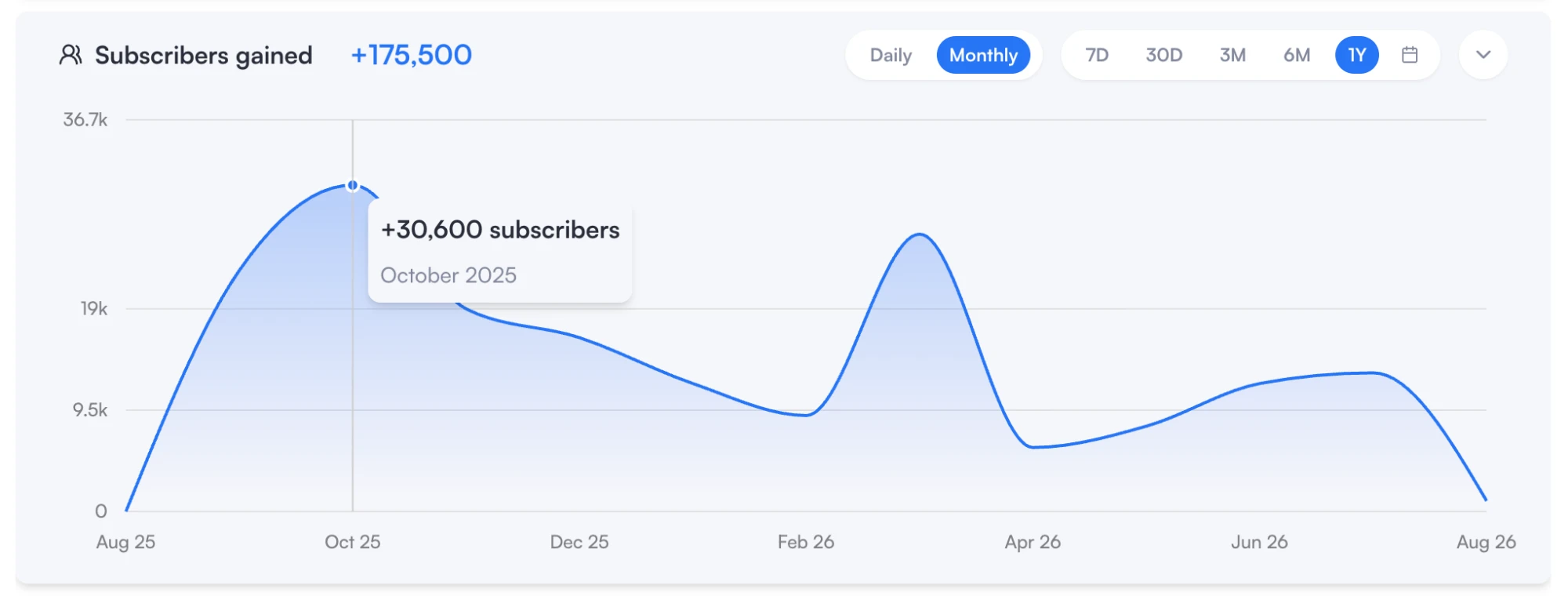
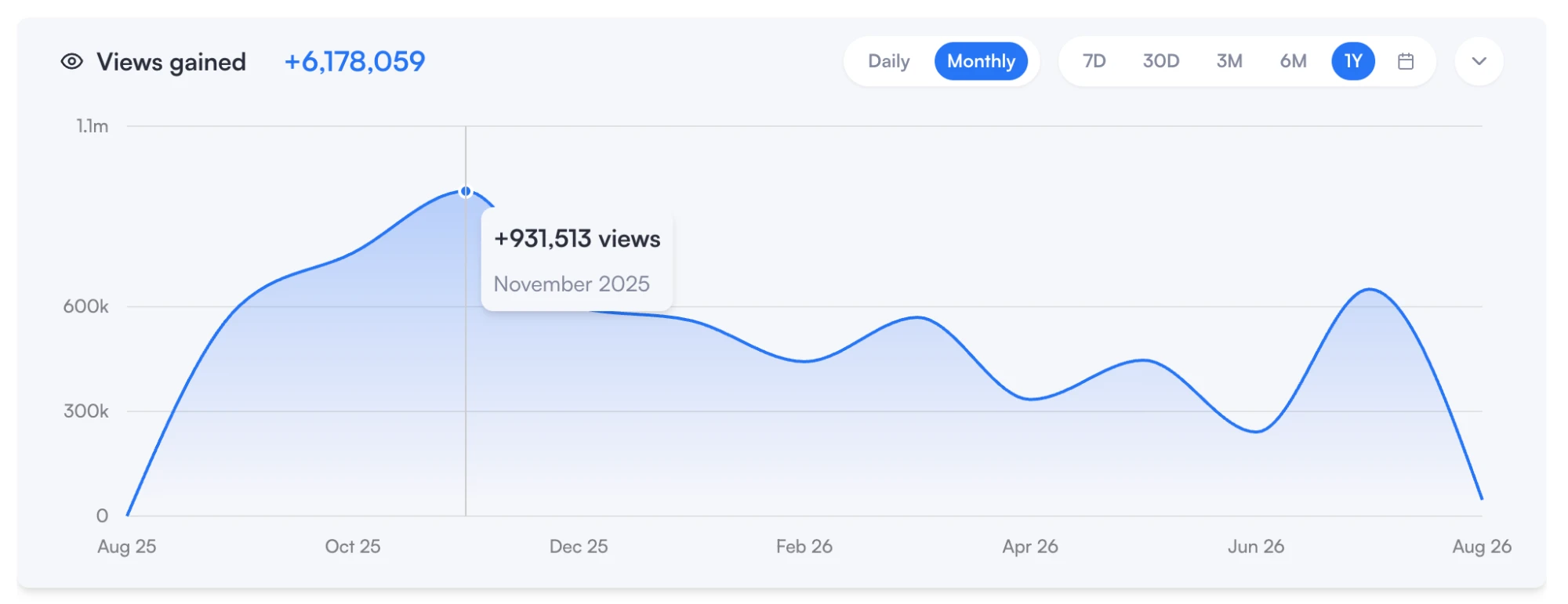
The growth chart has three obvious peaks, and the upload history decodes each one.
October 2025 was his best subscriber month: +30,600. It was month two of long-form, and the month he published two videos that still sit in his all-time top six: "Everyone Who Uses This Playbook Makes $1 Million" (288,000 views) and "The $1 Million Landing Page" (376,000). The daily record steepens right after the Landing Page upload, from under 600 new subscribers a day at the start of the month to more than 1,500 at the peak.
November 2025 was his best views month: roughly 930,000 gained. No viral hit is in it. He published four long videos in thirty days, his heaviest long-form month of the year, including "How to Become Famous in Your Industry (and Make $1 Million)", now at 312,000 views. Underneath them, October's videos were still climbing through their second month, which is exactly what the slow-burn curve predicts. The peak was stacked assets earning at once, not one lucky video.
March 2026 brought the second subscriber surge: +27,000, with more than half arriving in a single mid-March week. "Why You Must Build a Personal Brand" went out on 10 March and now stands at 276,000 views. Traffic sources aren't visible from outside, so I note the timing without claiming the cause: the surge began within a week of that upload.
The pattern across all three is the finding. His Shorts went out at a near-constant rhythm the whole year, so the variable that moved in every peak month was long-form. When the peaks came, they were made of long videos and their afterlife.
The takeout to try yourself: When you get a spike month, match the dates against your uploads and find what was different. Then repeat it on purpose.
The outliers pass the authenticity check
Big view numbers invite one fair question: were they bought? The engagement maths says no. Bought traffic leaves a signature - thin like rates, and comment counts far below what the view count predicts.
Every outlier here shows the opposite. His six biggest long videos run like rates between 3.1% and 4.8%. Five of the six carry more comments than their view counts predict, and the sixth pairs its quieter comment section with one of the highest like rates of the set. The viral Short sits at a typical organic Shorts profile. The growth this analysis describes is real attention, not purchased numbers.
The takeout to try yourself: Run the engagement maths on any channel before copying its playbook - healthy like rates and comments in proportion to views. Thin engagement is the signature of bought traffic.
SEO is a secondary consideration here. That's the strong personal brand at work
From a pure YouTube SEO read, the channel is barely optimised. Dozens of his videos carry no tags at all, the titles match no query anyone would type, and his 276,000-view personal-brand video doesn't rank for "how to build a personal brand".
None of it costs him, and the reason is measurable: around 3,600 people a month Google his name in the UK alone. Fifteen years of books, stages and podcast appearances mean the demand arrives pre-built. The brand does the job SEO normally does, and the feed delivers what the brand creates. Watching SEO become optional is watching a personal brand at full power.
The reader's version runs the other way. A brand at that level takes years to compound; SEO is the mechanism that does the same job in the meantime. It makes a channel findable on the merit of its answers rather than the size of its name, and the results page is the one surface where a small channel outranks a big one. He's earned the right to treat search as secondary. Until your name pulls thousands of searches a month, it's primary.
The takeout to try yourself: Until your name pulls thousands of searches a month, keep search primary: title videos in the words a buyer would type.
Inside the videos: what the transcripts show
The numbers say where the growth came from. The transcripts say why some videos grow and others don't. I read five, from his biggest to his weakest.
The winners open the same way: an everyone-problem, a compressed-experience promise, and a menu of what's coming. His 549,000-view sales video starts with "everything that I know about creating a great sales process as quick as I possibly can", lists the payoffs ahead, then frames the value outright: "it's taken me 25 years to share all the things I'm about to share with you for free." His weakest long video opens on team structure - a problem only a slice of his audience has this quarter.
Retention is engineered, not hoped for. He seeds open loops early: "you definitely want to stick around for the presentation and sales bit, cuz that's where the money hits the bank." He interrupts himself to hold you: "Don't skip ahead." He reframes the video's identity mid-way: "This is meant to be a training video. It's not meant to be a short piece of content that you consume as you're scrolling." And every video closes by handing you to the next one by name.
The biggest finding in the whole teardown is this. "25 Years of Sales Knowledge in 34 Minutes" has 549,000 views. "25 Years of Money Advice in 31 Minutes" - the identical template, three months later - has 36,000. Same formula, same presenter, 15x gap. Topic selection did that. His winners promise money made: sales, leads, landing pages, the habits of the very rich. His weak videos cover operations: hiring, goal-setting, generic business advice. The template fixes the packaging; the topic sets the ceiling.
The same pattern turned up on a second channel. When I ran the full 1,723-video library behind Simon Squibb's YouTube strategy, his compressed-experience title had been rerun four times and none of the reruns came close to the original. Two channels, one template, and on both of them the topic decided the ceiling rather than the formula.
The takeout to try yourself: Pick topics that promise money made and open on a problem most of your audience has. On identical packaging, topic choice opened a 15x gap.
He gives away the method and sells the shortcut
I read the transcripts too. His "$1 Million Landing Page" video - 376,000 views - is a complete build tutorial. The landing page structure. All fifteen quiz questions, word for word. The scoring logic. The results page. Ten straight minutes with nothing held back.
Then, near the end: "this entire system might seem like it's an incredibly difficult and complex system to set up, but it's all completely automated for you at scoreapp.com. I'm the co-founder of that software company."
He doesn't withhold the method to make you buy. He teaches all of it until you understand exactly how much work the job takes, then sells the shortcut. By the time the product appears, you've already agreed the problem is worth solving. The free assessment in every description works the same way - you diagnose yourself, then want the fix. It's the same mechanism that built his companies, running quietly under a YouTube channel.
The search data shows the loop closing. ScoreApp now pulls around 4,400 Google searches a month in the UK, more than his own name at 3,600, and advertisers bid around $9 a click on it (Google Ads bid data, USD). A software product out-searching its famous founder is what a working content funnel looks like from the outside.
The takeout to try yourself: Teach your full method on camera, then sell the version that does it for them. A viewer who understands the work is ready to pay to skip it.
What a business channel takes from this
Six decisions, all visible in public data:
- Long-form is the engine; Shorts are the garnish. On his channel the gap is roughly 22x per video, and the like-rate gap says the long audience is warmer, not just bigger.
- Assets beat fireworks. A video that still earns in month eight is worth more to a business than a viral spike that's dead in month two.
- Views from the wrong audience don't convert. His commentary Shorts prove big numbers can build nothing. What counts is whether the viewer matches the buyer.
- One channel, one promise. His three-channel structure keeps every promise clean - and the personal channel gets the reach, the brand channel doesn't.
- Package for the surface you're actually on. His titles are feed headlines, not search phrases - a choice, made deliberately, that fits how his viewers arrive.
- Teach the method, sell the shortcut. Generosity is the funnel.
Reading a channel this way - which videos pull their weight for the business, which audience actually showed up, where the next lever is - is a core part of YouTube channel management. The same analysis that produced this piece runs on client channels every month.
The takeout to try yourself: Pick one of the six decisions and test it on your channel this month. The format split is the cheapest to check.
How this analysis was done
Everything above comes from public data: the channel's full 486-video library, daily tracked subscriber counts, video-level view histories, live YouTube results pages, and video transcripts. Every figure was re-derived in code and cross-checked twice before publication; growth figures use tracked daily counts rather than modelled estimates.
Key verified numbers: subscribers 20,400 on 29 Aug 2025 and 197,000 on 7 Aug 2026 (tracked daily); trailing-twelve-month cohorts of 28 long videos (4,349,143 lifetime views, median 95,904) and 288 Shorts (2,038,145 views, median 4,382); the 4.4M Short at 85.9% of lifetime views in 28 days and +71 views in its latest month; the sales video at +40,908 in the same month.
What outside data can't show: retention curves, traffic sources, revenue, or what any of it converts to. Claims that depend on those are labelled as hypotheses above.
Analysis and write-up: Stewart Read.

Meet Stewart
Stewart Read
YouTube Growth Strategist
Stewart has run YouTube channel management for 8-figure businesses - turning channels into reliable sources of leads, clients, and measurable revenue, not just views.
Using a class-leading suite of channel analysis tools he built himself, he pinpoints exactly what makes your audience click, watch, and convert - then turns those findings into videos that bring buyers to your business.
Channel Intelligence
The monthly service behind this analysis. A written briefing on what your channel returned to the business, a video walkthrough of the findings recorded by Stewart personally, and a plan for the videos to make next.
See how Channel Intelligence works